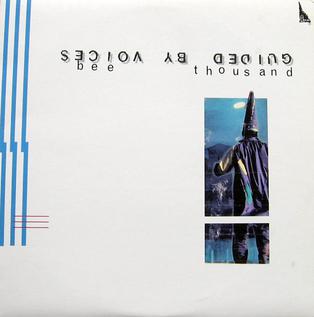
Guided By Voices
Bee Thousand (1994)
It's no surprise if you've never heard of Guided By Voices. If not for a good friend of mine, I'd never have heard of them either, even though bandleader Robert Pollard is considered one of the most prolific songwriters in music today (at last count, he has 1 669 songwriting credits). They have never been what would be considered 'commercially successful', however the band (and Pollard) are considered to be at the vanguard of lo-fi indie rock.
The album I've been requested to review (by said good friend) is 1994's Bee Thousand, which, according to some research, was thought by a number of critics to be one of the decade's defining indie releases (for example, it was named as the Best Indie-Rock Album of All Time by Amazon.com, while the actually respectable Pitchfork named it the tenth best album of the 90s.) So I'm really looking forward to it, not just because it is so highly recommended but because it represents my first dipping of the toe into the waters of GBV.
The Album
It's said that Pollard was following the 'four Ps' of rock here - punk, pop, progressive and psychedelia. I can honestly say that if this was his intention, he's fucking nailed it. Punk and psychedelic flourishes abound on Bee Thousand, although the overriding influence is that of 1960s British rock, pop and 'garage' music. The lo-fi quality of the recording merely adds to the 60s flavour, with the rawness and inconsistent mix quality adding to the feeling that what we're actually listening to are a shitload of lost demos from some forgotten British band of the mid to late 60s.
Although it's lo-fi, I must say that Pollard has coaxed out a magnificently lush sound at times, particularly in the harmonies that are present in songs such as Hardcore UFO's, The Goldheart Mountaintop Queen Directory and Echos Myron. Additionally, the guitars sound rich, yet abrasive for the most part...only occasionally are the mixes far too trebly, which leaves the songs sounding rather hollow.
When GBV go British Invasion here, it calls to mind some of British music's leading lights. The Goldheart Mountaintop Queen Directory is the sort of drug-addled psychedelic folk you could see The Kinks doing in their concept album phase, while the superb Tractor Rape Chain features a vocal from Pollard that could so easily have been laid down by Steve Marriott of the Small Faces. Echos Myron takes elements of the early Mod days of The Who, and Queen of Cans and Jars could have been an early psychedelic Status Quo demo.
Speaking of psychedelia, there's plenty of that to be found here as well. Hot Freaks delivers a trippy experience, helped by Pollard's vocal delivery that gently apes David Bowie on The Jean Genie. Peep-Hole is Syd Barrett reincarnate, right down to the lyrical content. The pick of the bunch is A Big Fan Of The Pigpen, which opens with a disjointed acoustic opening - the guitar sounds horribly out of tune, while the vocal is distant, as though it were recorded in a toilet. However, it quickly gives way to an electric guitar-driven psychedelic festival of sound...and it's glorious.
The punk ethos is best reflected in the tracks Her Psychology Today and Gold Star For Robot Boy, though don't expect to find the 90s skate punk/pop punk vibe here; Pollard instead opts for the anarchic barely instrumentally competent aesthetic of 70s punk. Both are really good tracks but the latter shades it for me; it burns with a real fire, despite the trebly mix, and Pollard's vocal is outstanding. The former is unusual in that the bass and drums are far more prominent than on other tracks, and it manages to blend punk sounds with the insanity of noise experiments such as Revolution 9, though its effect is somewhat diluted by the distorted acoustic guitar section at the song's close. Smothered In Hugs has hints of punk (mainly in the sizzling, driving riff) but its Dylanesque vocal stylings mark it as having more in common with 60s garage rock. It's one of the album's most outstanding cuts, consistently good from start to finish.
As is the pure pop of I Am A Scientist. If this song were cleaned up it would be perfect for radio - the melody is catchy and pleasant to the ear, the guitars sound less abrasive and it uses a fairly standard pop structure. It's a cracking little song that shows Pollard to be more than just indie/punk/psychedelia icon. Ester's Day also showcases pop sensibilities (though it was written by multi-instrumentalist Tobin Sprout), melding the lush harmonies of Simon and Garfunkel with the guitar pop stylings of The Hollies.
I realise that this makes Pollard (and GBV) sound like massive style thieves. The truth is, they aren't - the production and performance are unique, and the band's use of VERY short songs (the twenty songs on this album run for 37 minutes all up) mark them as distinctly their own men...however aesthetically, they call to mind so many influences of the past that it's impossible not to notice. What matters is how you use those influences, and GBV have used them to craft an album that is distinctly theirs.
The Verdict
Basically, Bee Thousand really is the bee's knees (I'm sorry.) It stands as a testament to what musicians can achieve with limited equipment. You don't need multi-million dollar studios or expensive recording equipment - all you need is a four track cassette recorder, some microphones, a place to record and some songs.
Additionally, when you have limited resources, and you're recording a lo-fi album, it's really the songs that need to be strong, to give the listener a reason to listen...and most of the album's 20 tracks are superb, if short. It's tough for me to recommend - many would find the poor quality of the recordings too offputting, or the short songs really annoying...but if you're game, and you want to give it a go, I think you'll be pleasantly surprised by just how good it is.
My rating: *****
Standout Tracks
I Am A Scientist
Smothered In Hugs
Tractor Rape Chain
A Big Fan Of The Pigpen
Queen Of Cans And Jars
Tomorrow, we go from '90s indie bands using 60s garage rock influences....to an actual 60s garage rock/pop band!

