Pages

Showing posts with label pop. Show all posts

Friday, 23 May 2014

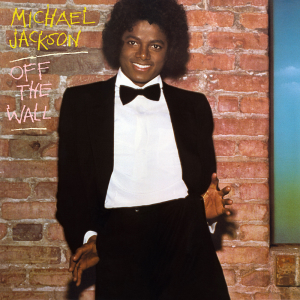
Album #141: Michael Jackson - Off The Wall


Michael Jackson
Off The Wall (1980)

The late Michael Jackson will forever be remembered for different reasons by different people. His army of loyal fans will choose to remember only his musical legacy, his undeniable stage presence and his incredibly array of dance moves; detractors will continue to highlight his questionable personal life, in particular the child sex allegations that haunted him from 1993 until his death, and which, even today, five years after his death, are continuing as others come forward claiming Jackson abused them.

Personally, I find his alleged actions abhorrent and sickening; and yes, I am aware that technically he was never convicted of any crimes....but where there's smoke there's fire, they say, and there's so much smoke around these things (still) that it's hard to accept that Jackson was completely innocent (even if he believed he was.) However, I do not think that devalues the musical work he did, and I do believe it is possible to listen to, judge and even enjoy Jackson's music without condoning his alleged actions.

With that rather lengthy disclaimer out of the way (and I have a horrible feeling it's going to trigger some debate), today's album is Off The Wall, Jackson's fifth studio album, but his first with Epic Records, where he did his finest, most career-defining work. 

The Album

Musically, the album covers an incredible range of influences. There's pop, soul, funk, R&B and disco scattered all over the place; there's even a tender ballad to top it all off. To make the album, Jackson enlisted the help of maestro producer Quincy Jones, the man with whom, in my view, Jackson did his finest work. He also worked with Stevie Wonder, Paul McCartney and Rod Temperton (who continued to work with Jackson on his next album, Thriller), each of whom contributed songs to the album.

For Jackson himself, this was the album where he was let off the Motown hook, finally free to pursue a mature, adult approach to songcrafting and production. The results speak for themselves; Jackson proves to have a superb sense of musical craft, not to mention finally allowing himself to show the full range of his vocal abilities. It might have numerically been his fifth studio album but make no mistake - Off The Wall is the birth of Michael Jackson, King of Pop.

Opener Don't Stop 'Til You Get Enough is a masterpiece - written solely by Jackson, and the first time in his career he had complete control over a solo piece. And holy crap, what a first time! Everything about this funk/disco odyssey just works - from the great strings and horn arrangements to the funky bass and disco/funk guitar...and there's Jackson's outstanding falsetto vocal for good measure. It sets the tone of the album perfectly, because it's disco/funk pretty much for the next twenty minutes. Rock With You heads more down the smooth R&B route but still has heavy elements of disco; Jackson drops his vocal back down to his usual smooth tenor and lends great gravitas to a rather good tune. Workin' Day And Night and Get On The Floor are more uptempo disco tunes; the former features some sublime horn work and a bedrock of electric piano, while the latter is a serious contender for the best track on the album; taking every conceivable cliche of disco (swales of string blasts, horns aplenty, a relentless backbeat, funk guitar) and fusing them together. The real hero though is bass supergenius Louis Johnson, whose slap bass work is not only funky as fuck but technically supreme.

The middle two tracks see a slight drop in quality and intensity. Off The Wall is a decent tune with a great hook, and more stunning bass work from Johnson; but in a rare display of compositional misstep, there's a grating falsetto shriek in the chorus which is rather offputting. Girlfriend is one of only two non-disco tunes, largely as it was penned by Paul McCartney. It's pure pop in sound and structure, but thanks to Quincy Jones it takes on more of an R&B feel. Following those is the ballad She's Out Of My Life (famous to Red Dwarf fans as the first song Dave Lister learned on the guitar), and while it continues the lull in intensity, it is an extraordinary song solely because of Jackson. It must surely rate as one of his finest vocal performances; his heart and soul pouring out of the speakers. The famous final seconds, where Jackson is breaking down in tears, are all thanks to Jones, who made the decision to leave that take in the final mix.

After this, Jackson clearly had had enough of all this wallowing, and closes by returning the aesthetic to cool disco-infused tunes. I Can't Help It is the Stevie Wonder-written tune and it's a smooth little R&B ditty with horns and electric piano aplenty; It's The Falling In Love and Burn This Disco Out close the album in much the same way it started, with funk/disco meeting R&B in a sweet, sweet fusion, even if these last two tracks don't quite have the same irresistible hookiness of the earlier songs.

The Verdict

I really, really enjoyed Off The Wall. This was my first listen to the album, although I'd heard all of Jackson's other Epic solo releases. If it wasn't for Thriller being so damn amazing I'd almost mount a case for this being the best one. Its greatest feature is that it blends the immense danceability of disco and funk music with oodles of pop sensibility, making it toetapping and entertaining.

Worth checking out.

My rating: 8.4/10

Standout Tracks

She's Out Of My Life
Don't Stop 'Til You Get Enough
Get On The Floor

Tuesday, 20 May 2014

Album #138: The Smiths - The Queen Is Dead


The Smiths
The Queen Is Dead (1986)

There's very little I can say about The Smiths that hasn't already been said by hundreds of other music writers. Extraordinarily influential on an entire generation of musicians that followed them (hi Britpop), they boast in Morrissey and Johnny Marr two of the most revered musicians of the 80s. Some critics have even said that the band are the most important guitar band of the 80s. Not bad for four Manc lads signed to an independent record label.

In recent years, Marr and Morrissey have seen themselves all over the music press, though for different reasons - Marr because of his dalliances with other bands (notably Modest Mouse and The Cribs) and his solo work, and Morrissey because....well, he's a fuckwit of the highest calibre. At any rate, despite his fuckwittiness, The Smiths are massively acclaimed, and prime candidates for the LOAD Project. I've chosen their third album, The Queen Is Dead, from 1986. I'm not gonna lie, I expect to have my mind blown.

The Album

I didn't have my mind blown.

That, however, does not mean that The Queen Is Dead is a terrible album; far from it. It's really rather bloody good...in fact I would even go so far to say as it's a fantastic listen with barely any noticeable flaws.

I'm just not convinced it merits OMGWTFBBQBESTALBUMEVARRRR!!!!!!!!!!111!111one!!!!eleventyone status.

What it is, is some fantastic indie guitar pop with a few minor flat points. Lyrically it's strong, apart from.....well, a few minor flat points. Its appeal is probably in the fact that when it's on, it's really on - musically and lyrically there are terrific moments of synergy, where the band show just why they were darlings of the critical and musical performer sets alike.

Moments of synergy like There Is A Light That Never Goes Out - lyrically brilliant (even if it treads on familiar ground that had previously been walked by The Who on Quadrophenia, all tortured young person who feels so alienated at home that they consider themselves homeless), and musically superb (guitar and bass provide a good groove, while synth strings add a mildly sombre touch to the massively depressing lyrics), Cemetry Gates (Morrissey's lyrical FUCK YOU to critics who slagged him off for 'thieving' the words of his literary heroes, set to catchy guitar pop), I Know It's Over (a ballad that throws back to the Mersey Beat sound, with a thick, groovy bass line from Andy Rourke, guitars and synth strings providing melody, some loose improv from drummer Mike Joyce, and a Morrissey vocal that is rather spinetingling....oh and some terrific lyrics, including the brilliant line, "It takes guts to be tender and kind"), Bigmouth Strikes Again (relentless Marr jangly guitar, a great bassline, and lyrics from Morrissey that are rather vicious, while painting the song's protagonist as a self-indulgent entitled wanker.), and Vicar In A Tutu (quite a fun tune - a shuffle beat, a walking bassline and a country-style picked guitar twang accompany some rather tongue-in-cheek lyrics from Morrissey, who shows a cheeky sense of humour to go with all the morose social commentary and depressing woe-is-me self-analysis.)

At other times, the synergy is close but not quite there: The Queen Is Dead is a great opener, all cynical snarl and social observation from Morrissey, jangly layers of guitar from Marr, rock-solid rhythmic power from Rourke and Joyce (in fact, Rourke's bass playing is immense)...it just goes a bit too long, finishing with an overly extended instrumental passage; Frankly, Mr Shankly takes on a bouncy 60s pop vibe and nails it pretty well, with breezy guitars and vocals (yep, even the morose Morrissey sounds happy), though it doesn't fit at all with the rest of the album; The Boy With A Thorn In His Side sees Morrissey direct a bunch of questions at the music industry, bemoaning the band's ignored status, and he delivers a great vocal to boot...musically it's okay, though I found the synth strings to border on the overbearing.

Even the two 'minor flat points' are just that - 'minor'. Never Had No One Ever has a simple, but meaningful, lyric - Morrissey's youthful lament about his childhood as an immigrant in Manchester - but musically, despite Marr's guitars sounding quite nice, it's desperately morose and plodding (I suppose it fits the music, but it's not particularly exciting or awesome; an admittedly minor quibble), while closing track Some Girls Are Bigger Than Others has the inverse problem - musically it's splendid, as multiple guitar tracks create an almost orchestral sound thanks to Marr's superb work, ably supported by Rourke's bass...but Morrissey contributes a fucking awful set of lyrics that were probably meant to be irreverent but come off as being purely shithouse, devoid of....well, everything.

The Verdict

I said I wasn't sure it necessarily deserved the mantle of GREATEST ALBUM IN THE WHOLE HISTORY OF EVER. I stand by that - give me Frances the Mute or Kid A or OK Computer or Highway 61 Revisited or Physical Graffiti any day of the week.

Yet The Queen Is Dead certainly deserves to be at least considered one of the (or possibly the single) finest albums released in the 1980s. It was the blueprint for so much indie guitar pop (and Britpop) that was to follow, and those roots can be heard clearly all over the album. Additionally, it's a slow burner; I liked it as I was listening to it, but it wasn't until going back over my listening notes and thinking about the songs that I realised that it actually was seriously good music by seriously good musicians.

So yeah, highly recommended, worth the hype, and clearly a terrific album.

Morrissey's still an utter fuckwit though.

My rating: 9.5/10

Standout Tracks

There Is A Light That Never Goes Out
I Know It's Over
The Queen Is Dead
Cemetry Gates

Friday, 16 May 2014

Album #133: Split Enz - True Colours


Split Enz
True Colours (1980)

True Colours marked the commercial arrival of Split Enz. I say 'commercial' because the band had actually produced several albums before this, featuring densely packed, bombastically arranged musical epics (some of which, if I'm honest, are seriously bloody good). However the success of I See Red, plus some well received poppy festival sets in 1979, convinced Tim Finn that melodic new wave pop was the way to go.

So it was that this album was the first to wholly pursue the powerpop sound, and consequently it was the launching pad for a few years of towering success (and arguably the launching pad for Tim's younger brother Neil on his path to musical glory.) I've never heard an Enz album in its entirety so I'm looking forward to it.

The Album

True Colours manages to fuse Tim Finn's desire for more melodic, poppy arrangements with elements of the band's earlier, more eclectic sound. Mostly, this is done through the magical keyboards of Eddie Rayner, who in my view elevates this album from good to great. His synthesiser stamps its authority all over this album, creating amazingly varied sounds and textures (added to that, he's a hell of a player). Though to be fair, he is working with some tremendous Finn-crafted material.

The album is famous for providing several of the band's best known songs. I Got You (Neil Finn's first truly great pop song) is worth every bit of its reputation. A great contrast between the uneasy verses, with their staccato guitar and synth swirls, and the dense, hooky choruses, is a great deal of the song's charm - additionally, the chorus is musically magnificent, rather simple yet rich. I Hope I Never is one of my all time favourite Enz tracks. Tim Finn delivers a fucking glorious vocal, paired with his own beautiful piano playing which packs a great emotional punch. While it's closer to baroque pop than anything, it still features Rayner's immense synth strings to add even more grandeur to the arrangement. Poor Boy is the third well known single, and it's decent; again, the mood is somewhat blue, helped by the morose chord progressions and Tim Finn's plaintive vocal. Nigel Griggs provides a notable bass line, but, again, the star of the piece is Rayner. His ethereal, spacey synth notes add texture to the verses, while the choruses are an extremely memorable keyboard line.

Outside the singles/well known tunes though, there's still some gold to be found - in fact it would be fair to say that the album features very few truly weak spots. Shark Attack is a bundle of high-octane energy, pumping out a punk-style tempo fused with synth-driven pop. It's a great opening track because of its frenetic nature (even if a recent superb cover by Dan Sultan and The Break shows that perhaps this song should have been a surf rock tune from the beginning). I Wouldn't Dream Of It is rather good new wave, right down to the heavy synth, groovy bassline and simplistic guitar melody, while Neil Finn's Missing Person keeps the new wave feel going but draws parallels with The Police. I also really enjoyed Nobody Takes Me Seriously, which shows the Enz's fascination with offbeat arrangements, jarringly discordant chord changes and distinctly un-pop pop. Finally, closing track The Choral Sea is a fascinating listen. Sonically it has more in common with the band's early, sprawling sound; swirling keyboard lines, a funky bass line with a very minor key change, some disco-style guitar rhythm work....all matched to a distinct disco backbeat from Malcolm Green. After about ninety seconds it dawns on you that you are listening to a Split Enz disco instrumental, and it may well be the best disco instrumental track ever recorded. The band maintain interest through the foreground of the soundscape - keyboard solos, drum and percussion breaks, guitar solos.....it's nowhere near being a pop tune and yet it's one of the album's gems, precisely because it has no intention of being a pop song. It's one hell of a way to end an album....

The Verdict

Deservedly regarded as one of the great Kiwi musical releases (NO AUSTRALIA YOU CAN'T HAVE THEM SO PISS OFF), True Colours really is a great pop album, though unlike today's idea of 'pop' it contains great lyrics, technically proficient performances and a willingness to find ways to create individuality within a pop framework. Most pleasingly, there's plenty of great material outside the big singles, and I think that's always the sign of a great album.

Thoroughly enjoyable and highly recommended.

My rating: 8.6/10

Standout Tracks

I Got You
I Hope I Never
The Choral Sea
I Wouldn't Dream Of It

Saturday, 10 May 2014

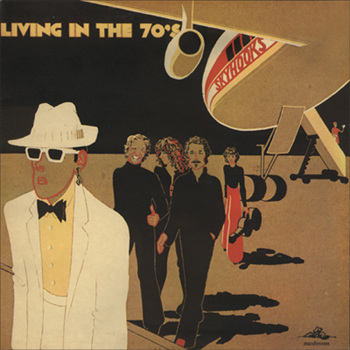
Album #129: Skyhooks - Living In The 70s


Skyhooks
Living In The 70's (1974)

People often forget, or don't realise, just how brightly Skyhooks' star burned in the mid 1970s. Their first two albums were chart toppers, they had a bevy of successful singles, and were a highly regarded live act (even if they had some detractors, who accused them of being little more than Kiss clones with their over-the-top theatrics). Yet like so many bands of the 70s, as quickly as the star burned, it faded away. Key members left, and the band were eventually put out of their misery. 

However, it's still worth celebrating their successes, as well as their importance to the Australian music scene. Their debut, Living In The 70's, was number 1 for sixteen weeks and is still regarded as one of Australia's best albums. Despite casually enjoying Skyhooks, I've never heard an album, and although I really wanted to do Guilty Until Proven Insane (because of Women In Uniform, no other reason) I thought I should explore a legendary album to evaluate its legendariness.

The Album

The genre label is 'glam rock' but Skyhooks' sound doesn't have the traditional glam influences. Instead, for the most part, it's pretty good guitar pop, albeit with some pretty impressive instrumental work from guitarists Red Symons (yep, the same one that was on Red Faces for many years) and Bob 'Bongo' Starkie, and the impressive Greg Macainsh on bass. Charismatic frontman Shirley Strachan also steals the show at times with some top drawer vocal performances, and his charisma and charm comes through in some of his vocals.

Surprisingly, while the album's singles (and best known tracks) are really damn good, there's a few cuts that come mighty close to trumping them. Living In The 70s and Horror Movie are the two big singles, and they're both solid cuts. The former is a straightforward guitar pop tune with a decent walking bassline, and lyrics that paint the experience of living in the 70s as rather disorienting, while the latter utilises two sparse intertwined guitar riffs, some spooky synth effects and some decidedly evil backing vocals to create an unsettling vibe (which suits the title and the lyrics). It ends up being great satire about the growing violence of TV viewing, extending out to the most horrific thing being the nightly news broadcasts.

You Just Like Me 'Cos I'm Good In Bed is famous as the first song played on Double J, and its whippy tempo and catchy riff (which is matched by Strachan's vocal melody) mark it as a fun, easy to listen tune, Balwyn Calling is a fantastic guitar pop/rock track with elements of 50s rock and roll, and some clever double entendre lyrics about the ancient art of picking up chicks in the suburbs, while Toorak Cowboy is, for all intents and purposes, a country song about Melbourne's gay scene - Strachan's vocal twang, the oh-so-country bassline and the guitar licks provide the sonic basis, while the lyrics deal with the 70s gay nightlife in a mostly respectful way. Red Symons' songwriting contribution, Smut, is also an interesting tune; Symons delivers most of the lead vocals himself and he's okay, though he's no Strachan (and it's noticeable when Strachan takes some lead parts on the song himself), the choruses are all harmonies and pretty guitars a la 10cc, while the lyrics appear to be about a man who enjoys porno theatres, until the last verse reveals that maybe, just maybe, it's not porno theatres he's relieving himself at.....

The other thing that made Skyhooks stand out was the use of local references. Being a Melbourne band, those references were to Melbourne locations (Balwyn, Toorak, Carlton), but at least an Australian band was revelling in its Australianness, not trying to hide it in order to be cool or hip. To their credit, when used here, those references don't feel shoehorned in; they feel like (and probably are) accurate representations of those locations at the time. Extra credit must also go to Macainsh, who wrote all the songs (save Smut) on the album and shows an ear for crafty pop.

The Verdict

I enjoyed Living In The 70s, and don't get me wrong, it's a really good album...but I'm not sure that it quite lives up to all the hype. I was expecting to be blown away...maybe I was expecting too much. 

Should you check it out? Yes, absolutely, because it is really enjoyable, and it's guitar pop from a time when 'pop' music could still be musically interesting and filled with great musicianship. It also doesn't have much in the way of crap filler; the album tracks are mostly rather good, and a couple almost on par with the singles. 

It's just not everything that its reputation describes.

My rating: 7.7/10

Standout Tracks

Balwyn Calling
Horror Movie
You Just Like Me 'Cos I'm Good In Bed

Saturday, 3 May 2014

Album #122: Badfinger - Straight Up


Badfinger
Straight Up (1972)

By rights, Badfinger should have been one of the biggest, and richest, bands on the planet in the 1970s. Shepherded through their early career by Paul McCartney, and possessing the influence of The Beatles in their music, the group produced several huge singles, particularly the McCartney-penned Come and Get It. Sadly, all the talent and pop magic would ultimately go unfulfilled, as the band became destitute despite their chart success; the victims of an unscrupulous, 'soulless bastard' of a businessman named Stan Polley, who ripped the band off of well over a quarter of a million dollars while ensuring the band received very little money from their success.

Tragedy continued to befall Badfinger; guitarist Pete Ham, his mental state shredded thanks to the band's financial dire straights, took his own life in his garage in 1975; bass player Tom Evans followed suit in 1983 after an argument with fellow (and at that time, former) bandmate Joey Molland over money. The study of Badfinger's history really is the perfect cautionary tale to all musicians who are breaking into the industry, even today.

Thankfully, their music still exists as a testament to the band's not fully fulfilled promise. Straight Up was their third album, and despite being a commercial success it was criticised heavily by some critics for the 'poor' production of Todd Rundgren (George Harrison also produced a few tracks on the album, but he avoided criticism). 

The Album

The term 'power-pop' has been coined to describe a sound like Badfinger's on Straight Up - lots of piano, organ and guitars, heavily tracked and luscious vocal harmonies and an abundance of pop hooks, wonderful melodies and standard vocal topics (love and all its related catastrophes). Those vocal harmonies are only possible because Ham, Evans and Molland are all very good vocalists, and all take lead vocal duties at times on this album (generally on songs they've written).

The album's two main singles are among the finest pop songs of the decade. Baby Blue is built around simple chords and an arpeggiated riff, with a heartbreaking, touching lyric penned by Pete Ham. Ham also delivers a stunning lead vocal, full of emotion and power, with support from Evans in the harmonies. The bridge in particular, where Ham is pleading "what can I do/what can I say?" is remarkably affecting. Day After Day is also a love song, though not quite as powerful, being more of the brooding variety. Also written by Ham, it's heavily overdubbed by producer George Harrison (who also contributes a fine slide guitar solo on the track; when you listen to it and compare it with Harrison's slide guitar parts on All Things Must Pass, or even his appearance on John Lennon's How Do You Sleep?, you can certainly tell it's a Harrison special). Even so, Ham's lead vocal stands out strongly, carrying a reflective, hopeful quality.

There's some other decent pop tracks on the album though that indicate Badfinger were a little more than just a singles band. Opener Take It All is classic power-pop, piano driven with Hammond organ support, and a throaty lead vocal from Ham; Tom Evans' Money weaves in some country blues influences through the main guitar lick, and has a great dual lead vocal from Evans and Ham; Name Of The Game is immense in terms of the harmony backing vocals, which have been overdubbed about a hundred times; its piano and acoustic guitar instrumentation mark it as an early progenitor of the power ballad, and it's a great song (apart from Ham's lead vocal being drowned out by the backing vocals at times, which is a major production mistake in my view.)

There's more bluespop with Suitcase, where the licks are British blues and the vocal is gutsy, while Sometimes acts as a throwback to the early/mid 60s guitar pop sound of The Beatles, featuring a catchy chorus and a tempo perfect for boogieing. Most of the great songs though are written by Ham; Evans and Molland do contribute songs here, but they're not great (Money aside), and Molland's songs in particular (Sweet Tuesday Morning and Flying) are the weakest on the album; still 'pop' songs, but not as catchy, and further hindered by Molland's comparatively weak vocal when compared to the much more talented Ham and Evans.

The Verdict

For giving us Baby Blue and Day After Day, Straight Up is of great value. Delving deeper into the album though reveals that, indeed, Badfinger were crafters of fine pop with catchy hooks and beautiful harmonies. It's worth checking out.

My rating: 7.4/10

Standout Tracks

Baby Blue
Money
Day After Day

Wednesday, 30 April 2014

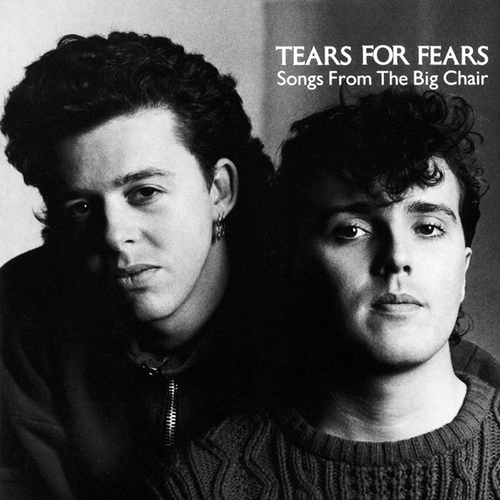
Album #120: Tears for Fears - Songs from the Big Chair


Tears For Fears
Songs From The Big Chair (1985)

After the monstrosity that was Here Come The Drums the other day, I was forced to listen to Tears For Fears' classic track Head Over Heels, to wipe the heinous memory of Rogue Traders from my mind.

Upon completing my listen, I realised that I really, really wanted to review a Tears For Fears album. Not only because they're a great band (with the distinction of having their first three albums chart massively in Britain) but because I've always felt that they've not received all the credit they deserve, being overshadowed by other pop artists. Despite me trying to steer away from the obvious sometimes, I felt there was no better album to choose than the one that is considered their defining album, Songs From The Big Chair.

My main question was a bit like when I reviewed Icehouse though - is it just singles, or is there something more to Tears For Fears?

The Album

Unlike Icehouse, there's something more. The band's lush arrangements and production, utilising a standard 80s blend of guitars, bass, drums and synths, are key features not just of the singles but of the album tracks also. Additionally, it's the way that the band fuse together all those swirly layers of synthesiser and guitar that give the songs a particular personality. The hero of the album though is bandleader and chief songwriter Roland Orzabal. It would do him a disservice to say he's just a pop songwriter - sure, he penned his share of great hooks on this album - but there's also nuance, feeling and craft present in his work here....and not just on the big songs.

Those three big songs though are absolute monsters, and all are deservedly thought of as some of the most instantly recognisable from the 80s. Shout is a sprawling, synth/bass driven ode to protest, with a jangly guitar lick playing a supporting role throughout. Orzabal's lead vocal is splendid, sending tingles down the spine at times, and there's even a fairly simple, yet powerful, guitar solo at the song's conclusion. Everybody Wants To Rule The World is sublime pop; all instruments work together and, at times, take the lead (the verses are basically synth and bass, while the guitars play prominence during the choruses...and there's even a couple of guitar solos to boot). The song is brilliantly crafted (witness the guitar-driven bridge in the mid-section which breaks the song up beautifully) and Curt Smith's vocal of some more quality Orzabal lyrics about the powerhungry is terrific. Head Over Heels is a superb pop love song, though (and this may be controversial) it's my least favourite of the three. Synths again drive the song, which interestingly falls in the middle of a kind of sonata (sandwiched by the song Broken twice, albeit with the second version being live and abbreviated).

Outside of those three big songs (and accompanying sonata tune) there's only four other tracks on the album, and they are a bit of a mixed bag. The tender, touching ballad I Believe (written by Orzabal originally for Soft Machine drummer, and 60s prog legend, Robert Wyatt) is a brilliant, brilliant tune. Lush piano fills the soundscape, supported by flourishes of saxophone, while Orzabal's vocals alternate between a soft, heartfelt croon and, later, more powerful acclamations. Listen is a pretty tune with a very hooky melody, with anthemic synth strings, wind chimes and opera vocals - in fact, it has many hallmarks of ELO-style pop. Unfortunately, it might be pretty (and Curt Smith, again, does a great job on lead vocal) but it really meanders around, not going anywhere. The Working Hour overdoes the sax solos horribly (funny sidenote- the man providing the sax solos on the album, Will Gregory, is now one half of the electronic duo Goldfrapp) but there's enough of the lavish Tears For Fears musical style present to, again, make the song a decent listen. Lastly, Mother's Talk, which was a single from the album also, is nowhere near the same class as the other monstrously successful songs. Yes, its mountainous-sounding drums rumble with pure power, and the synthbass line is pretty damn cool, but there's no hook to speak of and because there's no hook to attach to, this pop song ends up....well, not very poppy at all. It's the only song on Songs From The Big Chair I didn't like at all.

The Verdict

Songs From The Big Chair is surprisingly good. Those classic songs help, of course; they'd be worth stars on their own; but even some of the album tunes have that earcatching Tears For Fears trademark sound. It'd be a great driving album for when you're touring through boring country, because there's plenty of interest going on in each soundscape.

I'd recommend it, especially if you already know/like some (or all) of the band's big hits.

My rating: ****

Standout Tracks

Shout
Everybody Wants To Rule The World
I Believe
Head Over Heels

Tuesday, 22 April 2014

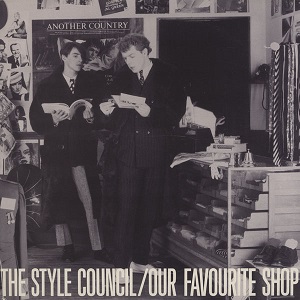
Album #110: The Style Council - Our Favourite Shop


The Style Council
Our Favourite Shop (1985)

After leaving seminal mod revival band The Jam in the early 80s, Paul Weller sought a new musical challenge. Eschewing the mod rock/punk sound of his previous group, Weller took on a brand new set of inspirations, namely soul, funk, jazz and synthy new wave. Pairing up with former Dexy's Midnight Runner, keyboardist Mick Talbot, Weller formed The Style Council, a new group with a new sound.

The band was also a vehicle for Weller's political viewpoints. Disgusted with the state of Thatcherite Britain, especially if you weren't in the elite upper class, Weller used The Style Council as a conduit for his most politically biting, occasionally savage, lyrics. 

Our Favourite Shop, the album Weller himself describes as the 'culmination' of the band's musical visions, is up there with any punk album (if not exceeding them) in terms of sheer 'fuck you'-ness, even if, musically, it is anything but punk.

The Album

There's quite a range of styles and sounds on Our Favourite Shop - a veritable council of styles, if you will (OH I CANNOT BELIEVE I WENT THERE.) The only common thread is that all the songs, even the not so good ones, are pure pop; there's nothing aggressive or harsh, it's all sweetly produced with lots of jangly guitar, Hammond organ and piano, with other instruments added for extra emphasis.

Featuring on the album are several jazz numbers (Homebreakers and the instrumental title track are straight up jazz, while Down By The Seine is French flavoured, right down to the French accordion, and With Everything To Lose takes a more Latin jazz turn), some new wave tunes (the synthy The Lodgers and the Simply Red new wave/funk/R&B hybrid Boy Who Cried Wolf), by the numbers pop (Luck and Shout To The Top), a touch of reggae (All Gone Away) and even a few sonic nods to Weller's past life (the rocking, uptempo Walls Come Tumbling Down, the Kinksish Come To Milton Keynes, resplendent with strings, harps and horns, and A Man Of Great Promise).

As if that wasn't enough, the band even fits in an Eleanor Rigby clone, right down to the arrangement of solo vocal over string section (A Stone's Throw Away).

As I said, covers a lot of territory.

It's lyrically where this album shines, however, and interestingly, the anger, bitterness, disillusionment, hopelessness, despair and rage that Weller's lyrics (and drummer Steve White's on one song) convey are rarely, if ever, matched by the music. Musically, it's all sweetness and light while Weller's words snarl underneath. Take, for example, the first three tracks. Homebreakers takes aim at the Conservative government of the time, snarling about taking revenge on "whoever came up with this economy plan" and pointing out the sheer detached snobbery of the Tories' dismissive "move if there's no jobs in your town" approach to rising unemployment of the working classes. Yet the music is smooth, smoky jazz pop that is quite easy listening. All Gone Away is jangly, jaunty reggae; the lyrics talk about the desolation of a northern mining town (assumed to be Bradford) when there's no work for the town's main industry. Come To Milton Keynes is all optimism and light, as are the lyrics for the most part; however the song's denouement unveils the satire behind the curtain, pointing out that the optimistic New Town schemes were, really, doomed to failure (or at the very least sorely detached from reality.)

The politically charged theme continues from there, though not quite as obviously contrasting with the music. Internationalists essentially acts as a detailing of the socialist manifesto, A Stone's Throw Away bemoans 80s Britain's decent into police and political violence against disgruntled citizens, The Stand Up Comic's Instructions (featuring an enthralling guest vocal from comedian Lenny Henry) chides the white 80s comic set for their casual racism, The Lodgers attacks the conservative exploitation of aspirationalism.....by the end of the album you're in no doubt where Weller's loyalties lie.

The undoubted highlight - the perfect maelstrom of supercharged lyrics with supercharged music - comes in the form of Walls Come Tumbling Down. From the outset, with Weller's growled "You don't have to take this crap" directed to the listener, we have the scene set. Weller produces a vocal performance worthy of the attack-dog lyrics, passionate and angry, while the song's tempo and horn section act as a rousing call to arms. It's a great tune and it comes right at the end of the album....the wait is worth it.

The Verdict

It won't set your ears alight musically, but for diversity of styles and for observing a lyrical master at work, Our Favourite Shop is a rather good album. As a perfect encapsulation of the time of its recording, it works beautifully, and given the current conservative political climate, some of the lyrics go to show that, even thirty years later, some leopards never change their spots.

However, there are other themes that are peculiarly British (a charge that Weller has always had laid at him, and may be part of the reason he's never been overly successful outside of Britain) which can make it tough to connect to some tunes, especially if you have no knowledge of the political and social climate surrounding the album.

Nevertheless, it's decent, and it contains some songs that are among Weller's finest efforts.

My rating: *** and a half

Standout Tracks

Walls Come Tumbling Down
Homebreakers
Internationalists

Tuesday, 15 April 2014

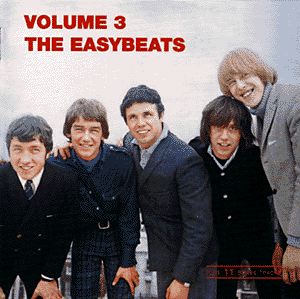
Album #104: The Easybeats - Volume 3


The Easybeats
Volume 3 (1966)

The Easybeats are the prototype Australian rock band. Every pub rock group that followed in their footsteps can be traced back to the British-inspired rock sounds of these five Australian lads (well, two were Dutch, two were English and one was a Scotsman....) Of those lads, two (George Young and Harry Vanda) were to play a critical, pivotal role in the development, production and popularity of some of Australia's biggest acts, including The Angels, John Paul Young and AC/DC (with George being the elder brother of Acca Dacca lynchpins Angus and Malcolm Young), while lead singer Stevie Wright went on to write and perform the sprawling opus Evie.

The group are better known for a string of hits, including She's So Fine, Friday On My Mind, I'll Make You Happy and Sorry. However, such was the group's popularity in Australia, they also released several high-charting albums. Volume 3 was the third of these (I know, shock horror with that name). I'm keen to see if the group had anything outside of the big hits.

The Album

Basically, imagine every cliche of early to mid 60s pop/rock rolled into one neat little package, and you've got Volume 3. It never, ever threatens to be anything more than a bog-standard collection of short pop tunes designed to capitalise on the band's status as teen heartthrobs. I almost feel dirty saying that about such a legendary band, almost as though I'm dismissing them. I don't really want to dismiss them per se, but (at least on Volume 3) if you strip away the singles then there's not really much to get excited about.

Opening track (and well known single) Sorry is by far and away the most outstanding track here. With a chuggy riff that stays in the brain long after the song is finished, and with vocalist Stevie Wright turning in a powerhouse performance, it's definitely a superb bit of pop songcraft. You Said That is influenced by mod sounds, and shows off the group's ability to create lush vocal harmonies, and the plinking one note piano line adds a nice Kinksesque touch. Today features a twangy, solid lead break from guitarist Harry Vanda within a solid pop rock tune, and Say You Want Me is a pleasant little Beatles clone, all vocal harmony and unobtrusive musical arrangement.

Beyond that though is a collection of uninspired, by-the-numbers pop rock that might have been popular in the 1960s, but looking at it today it comes off as tired and bland. What's worse is that, Vanda's guitar playing aside, there isn't anything that threatens to lift these album tracks beyond the mundane - even The Beatles and The Stones had musicianship, vocal brilliance or even clever turns of a lyrical phrase to fall back on. The songs here simply don't have that.

The Verdict

As a singles band, The Easybeats kicked much arse. As an album group, they leave a great deal to be desired, if Volume 3 is any indication. Its biggest crime is that it is, a few tracks aside, utterly boring, and a chore to listen to.

Get Sorry, avoid the rest.

My rating: * and a half

Standout Tracks

Sorry
Today

Tomorrow, a behemoth of a metal album from a kickass Swedish outfit, who have pretty much covered every subgenre of metal during their career.


Sunday, 13 April 2014

Album #102 : Kaiser Chiefs - Employment


Kaiser Chiefs
Employment (2005)

Leeds five piece Kaiser Chiefs (named for the South African club of former Leeds United skipper Lucas Radebe) exploded onto the British music scene in early 2005 with their debut album, Employment. Prior to that, the group had attracted great attention from A & R people for their catchy pop sensibilities tied to a sound rooted in post-punk, new wave and Britpop. Success for the group seemed a matter of time.

Though I doubt even Ricky Wilson, who famously once said he would "wank a tramp" to ensure musical success, would have expected this album to shift in the order of three million units. 

When it was released I remember being very impressed by the quintessentially British nature of the music and lyrics, and thinking that the band were destined for great things. Now, whether or not they've gone on with that is debatable...but today I thought it would be good to take a look back at this album and see if it really is that good.

The Album

Full of bright, catchy guitar pop (and the occasional trip into edgier territory), Employment really is a typical 'good' debut - mostly good tracks but occasionally inconsistent. At its best, it's full of singy 'lad' choruses and plenty of 'na-na-na' moments, perfect for drunken incoherent rambling chanty singalongs. Hooky guitar riffs sometimes mingle with keyboard lines and it's underpinned by a sound rhythm section. At its worst, fairly trite lyrics are interspersed with grating musical approaches (though even some of the better songs contain dodgy lyrics.)

The band's ability, identified in their early years, to write catchy guitar pop comes to the fore in the album's opening three songs. Everyday I Love You Less And Less takes some forced rhymes and fairly bitter themes, combines them with a simple keyboard riff and jangly distorted guitar and produces a toe-tapping pop tune. The pick of the three is I Predict A Riot, with its savvy and accurate depictions of a standard Saturday night out in Leeds - drunken twats spoiling for a rumble, overzealous policing, girls out on the pull - married to a dark indie/punk riff. The third track, Modern Way, is the most radio-friendly of the three, with a lush, inoffensive-sounding chorus and comparatively quiet verse. All three also contain those big 'lad singalong' choruses, as does the overrated Oh My God (which, lyrically, makes very little sense, but it does provide an acceptable attempt at an anthemic Oasisesque monster chorus.)

The group turns their attention to more raucous indie on the tracks Na Na Na Na Naa (which takes the na-na-na chorus to its questionable zenith, even if it is a fun, catchy song) and Saturday Night (which is resplendent with a guest appearance by Graham Coxon's motorbike). There's more inoffensive but listenable pop tunes in You Can Have It All, built around a whiny keyboard riff, and the rather boring Born To Be A Dancer and Time Honoured Tradition.

There are also some pleasant diversions away from pure guitar pop. There's the Beach Boys wannabe schtick of Caroline, Yes (and yes, the title is based on the Beach Boys' Caroline, No), as the band layer multiple overdubbed vocals to create a wall of sound in the choruses, and there's also a bit of a hidden gem in What Did I Ever Give You, featuring a distinctive organ opening, a slow, contemplative tempo and an equally contemplative lyric about acknowledging one's bastardry towards a loved one. 

The Verdict

Employment is indeed a good, catchy guitar pop album. Its influences merely add flavour to the band's favoured pop aesthetic, rather than dominating the album's sound entirely. I'd still argue this is their best album, even if it is rather inconsistent, and I'm not sure they've ever really lived up to the promise that Employment showed....but nonetheless, it's an album worth giving a spin.

Just don't expect your musical world to be blown away. It is, after all, just a standard pop album with poor lyrics. 

My rating: ***

Standout Tracks

I Predict A Riot
What Did I Ever Give You
Everyday I Love You Less And Less

Tomorrow, a real genuine lo-fi release, and another request met!

Thursday, 3 April 2014

Album #93 : The Beach Boys - Pet Sounds


The Beach Boys
Pet Sounds (1966)

The Beach Boys found fame in the 1960s composing and producing songs about surf, sand, cars and babes....and nothing else. Their brand of surf rock, featuring multi-layered vocal harmonies and rocking arrangements found a home in America, the land of surf, sand, cars and babes (and nothing else).

By the mid 1960s, though, and with his mental state growing more fragile, the group's talismanic genius, Brian Wilson, had grown tired of churning out album after album of surf rock. On the verge of burnout, he began to become not only more introspective of his mental demons, but also sought to push the boundaries of musical production. Inspired by The Beatles' Rubber Soul, which he saw as the perfect album, Wilson set out to create something better. The result was Pet Sounds, incredibly the band's eleventh studio album in five years.

It was to play a part in the redefinition of pop and rock music. It was also the beginning of the end for the Beach Boys as a chart-topping force.

The Album

Drawing largely on baroque influences and instruments, Pet Sounds is far removed from the early surf rock sound. Guitars and drums are at a minimum, replaced by horns, strings, harpsichords, flutes and percussion. However, those famous vocal harmonies are turned up several notches, and were never better at any time in the band's career than right here (save for Good Vibrations, perhaps). Additionally, Wilson's growing experimentation with LSD meant the songs also took on a psychedelic edge, with a heavy use of reverb on instruments and vocals (one example being I Know There's An Answer, which was written during Wilson's second acid trip). The result is the most experimental, boundary-pushing Beach Boys album in their entire catalogue.

The songs themselves are a testament to Brian Wilson's abilities as a songwriter (though he was ably supported with lyrics by Tony Asher). Wilson's gift for creating melody and weaving intricacy into a song's arrangement is all over the album. Leading the way is a song that deserves consideration as one of the finest ever written, God Only Knows. One of the few tracks not sung by Wilson (his brother Carl takes the lead vocal), it is utterly gorgeous. French horns and harpsichords play us in, before Carl Wilson's lead vocal takes us to a higher plane - haunting, beautiful, crisp. Baroque influences abound due to the ever-present harpsichord, and at the song's denouement, C Wilson, B Wilson and Mike Love's vocals swirl around each other creating a kind of vocal Shepard note. 

It simply must be heard.

That's not all though. Wouldn't It Be Nice is one song closer to the 'old' Beach Boys sound, featuring a more traditional rock percussion track, though the instrumentation is gloriously lush with horns, accordions and guitars. It takes an optimistic tone musically, and this is supported by a set of hopeful lyrics. Sloop John B, based on an old West Indian folk song, is a highly underrated tune. More great vocal harmonies (there's a brief moment near the end where it's just the vocals alone, and it's stunning) and a simple folky chord structure make the song such a great listen. Also of an upbeat mood is I'm Waiting For The Day, with its BIG choruses (featuring booming drums and strings, as well as vocal harmonies) and even bigger coda.

Most of the album's tracks, however, would be classed as 'baroque pop', and there's some variety in these baroque tunes (which, to be frank, there needs to be; I find baroque pop to be good as something different, but it shouldn't be an album's dominant musical landscape.) They range from the dreamy yet doleful You Still Believe In Me and the short, yet pretty instrumental Let's Go Away For Awhile, to the downbeat yet beautiful Caroline, No and Don't Talk (Put Your Head On My Shoulder). The latter two are almost as good as any of the 'big' songs on Pet Sounds; the former with a downbeat melody, accentuated by Brian Wilson's double tracked lament and the soft tones of a vibraphone, and the latter featuring sombre, yet creative, chord progressions and the gentle emotion-generating string arrangement.

There are also signs of the demons that were beginning to plague Wilson, encapsulated partly in the song That's Not Me (which, interestingly, was actually sung by Mike Love). Wilson himself thought the song related perfectly to him, although when it was written by he and Asher that wasn't the intention. However, the track I Just Wasn't Made For These Times entirely sums up Wilson's mental state, as he began to believe that his musical visions were far outstripping the technological capabilities of the time, as well as dealing with people who thought that Pet Sounds was too ambitious. 

Which, in fairness, it probably was.

The Verdict

We, however, should be thankful for Wilson's ambition. History records that Pet Sounds became the catalyst for so many bands to reinvent their sounds; upon hearing the album, Paul McCartney was inspired to continue the musical arms race, leading The Beatles to compose and record Sgt. Pepper's Lonely Hearts Club Band, which also helped change the face of music. A massively diverse range of musicians, from Elvis Costello to somebody called Biffy Clyro, have cited the album as inspirational.

In terms of songwriting and production, it truly is one of the great albums. It helps that it's also just so damned beautiful to listen to. It's not quite perfect though - for mine, it lacks those electrifying goosebump moments that elevate great albums to another level (although, I'll grant that God Only Knows is one great big electrifying goosebump moment) and it goes back to the baroque/psychedelia well a little too often. 

As far as that Rubber Soul comparison? Well, Pet Sounds has higher highs, but Rubber Soul is more consistently good. So it's not quite a five star album because it doesn't quite have that consistency of quality....but it is, nonetheless, an album that you must listen to if you've never heard it. The Beach Boys (and rock music) would never be the same again because of Pet Sounds.

My rating: **** and a half

Standout Tracks

God Only Knows
I Just Wasn't Made For These Times
Sloop John B
Caroline, No

Tomorrow, another request album!

Thursday, 27 March 2014

Album #86 : Pink - Missundaztood


P!nk
M!ssundaztood (2001)

I genuinely, honestly, have never seen what the big deal is about Pink. Really, truly. Is it the attitude that straddles perfectly the line between honest personality and manufactured confection designed to appeal? Is it the undeniable vocal talent? Is it the fact that she is one of the few artists in modern pop music who generally doesn't rely entirely on hired gun songwriters (though let's not bullshit here - there has not been a single album song released in her entire studio career that hasn't had the services of a hired gun songwriter to provide some guidance) to develop her material? Or is it the influence she's had on pretty much every female pop star in the last ten years?

To tell the truth, it's probably all of those things and more. Though I may not get the big deal, it can't be denied that Pink is a big deal. 

Therefore it seemed only logical that the LOAD Project take on a Pink album, given her profile and importance to modern music. I've selected 2001's disgustingly-spelt album M!ssundaztood (yeah there's an exclamation mark in there; no wonder the standard of modern English has gone through the toilet.) Let's see what it has to offer.....

The Album

The copy I'm reviewing is the international version of the album. Interestingly, my research told me that the American copy basically flooded the first few tracks with all the singles, thus following Modern Pop Album Rule One: Put the singles first because nobody gives a shit about the rest of the songs, and they will still say your album is OMGWTFBBQAMAZEBALLS even though they only listened to the first five songs. The international version is different, spreading the album's four singles throughout fairly evenly.

It's the singles that I'm going to start with, and they're a mixed bag. On the positive side, Get The Party Started is aptly titled, because it's a great dancepop party tune. Clever horn and synth samples make up the bulk of the sound, and it manages to sound like an 80s/90s pop tune without being a massive ripoff. Family Portrait is probably the standout song on the entire album. It's an emotionally charged song about Pink's parents' divorce, and tells perfectly the story of a divorce from a child's point of view (right down to the self-blame and the belief that they can make everything better). It's told in a soul-tinged ballad with a magnificent vocal.

On the negative side, Just Like A Pill is full of all the typical pop cliches - quiet verse, prechorus buildup, chorus sound explosion, repeat the chorus ad infinitum until it's stuck in your head - but it's just a mediocre pop-rock song, while Don't Let Me Get Me commits the cardinal sin of being a song, sung by a white girl with a steadily building musical profile on the verge of mega stardom, that cries WOE IS ME MY LIFE IS PAIN and wallows in self-pity. Added to that is the fact that it's just so middle-of-the-road that it engenders no feeling. To think that some dude described this as 'power rock'. Mate, it's as powerful as Andre Rieu.

On to the album tracks, then, and perhaps this is the big surprise - there are some mighty fine cuts here. The best of these are the Richie Sambora (Bon Jovi) and Richie Supa (Aerosmith) penned Misery, with its 60s soul-meets-gospel-meets-modern pop ballad, and a cool guest vocal from Steven Tyler; Eventually, a mighty fine R & B ballad that might be 'by the numbers', but they're the right numbers (tasteful guitar, subtle synths, gentle drum and bass, and a top class vocal effort); and Gone To California, another nice R & B style tune with good lyrics and a smooth saxophone solo that manages to elevate this song above the average.

There's also some songs that, frankly, are little more than album filler designed to ensure that the consumer isn't being shortchanged, and possibly to boost the royalty coffers a bit more. 18 Wheeler is supposed to be all LOOK AT ME I AM A BADASS AND I WON'T TAKE YOUR SHIT attitude. Unfortunately, it overlooks several key factors:

  • If you were run over by an 18 wheeler, you would probably be kept down due to being incapacitated at best, deceased at worst; and
  • If you're such a OMG ATTITUDE BADASS, why have you censored the word 'fuck'? What's that? To avoid a Parental Advisory sticker? WHOA TAKE THAT WORLD! STICKIN' IT TO THE MAN
Anyway, where was I? Oh yeah, shit album filler tracks. Missundaztood is dreadfully boring (at least 18 Wheeler shows some fucking personality, this song has all the personality of tofu). Respect sees Pink try to drop science, busting MAD RHYMES YO. Unfortunately, she's quite shit at it. Dear Diary manages to take the tried-and-tested formula of the 90s acoustic guitar pop ballad and somehow suck the life out of it.

To finish on a positive note though, two things; firstly, when she's not attempting to rap, Pink is phenomenal. She displays such an adept vocal range through the album, shifting from rock chick 'tude to Dusty Springfieldesque soul smoothness. Some of the songs might be terrible but that's not a complaint you can level at her singing. Secondly, the guiding hand of Linda Perry is a boon for this album, helping out with a clever lyric here, an earwormy pop hook there. Her presence is part of the album's charm.

The Verdict

There's brilliant, there's good, there's bland, there's bad and there's utterly terrible....and all five are here on Missundaztood. To be honest, I found the album a frustrating experience. Fantastic songs were often lost among the uninteresting noise, which is a disappointment. What I was pleased about was that within the album tracks, there were a few little gems...which, for me, is always one sign of a properly talented artist.

It's safe to say that I get the big deal a little more now than I did before...but you'll forgive me if I think that in terms of pure musical value, Missundaztood is, on balance, a distinctly average album.

My rating: ** and a half

Standout Tracks

Family Portrait
Eventually
Misery

Tomorrow, I bring you an album that promises to be another one of those 'so bad it's hilarious' releases.....